

Almost every business today is “using AI” in some form. Someone on the team is using ChatGPT. Another person is experimenting with Gemini. Someone else prefers Claude. On the surface, it looks like progress.
But when you zoom out, a more important question appears:
Is AI improving the quality of decisions and outcomes across the business, or is it only accelerating day-to-day work?
This is where the idea of the AI Maturity Continuum for Enterprises becomes useful. It helps explain how AI adoption evolves inside organizations and why most companies feel stuck despite using powerful tools.
Let’s walk through the three stages.
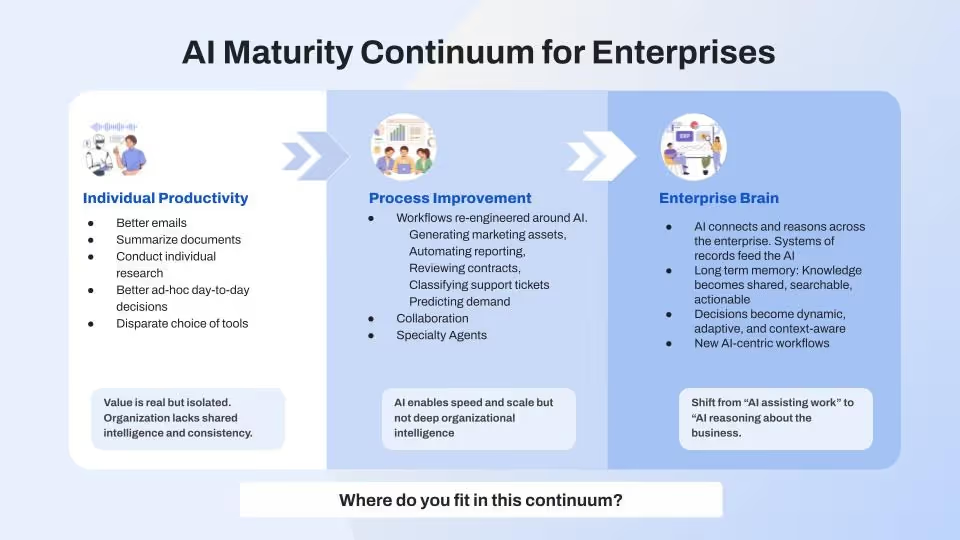
Stage 1: Individual Productivity
AI as a personal assistant
This is the starting point for almost everyone.
At this stage, AI is used by individuals to make their own work easier:
- Writing or improving emails
- Summarising long documents
- Doing quick research
- Creating drafts of content
- Making better ad-hoc, day-to-day decisions
People usually use free or personal versions of AI tools. The choice of tool is disparate; each person picks what they like or what they’ve heard about. There is no standardization, no shared approach, and no common learning path.
The value here is real, but it is also isolated.
One person might be very good at using AI and get a lot out of it. Another might barely touch it. There’s no organized way for the organization to help people get better, and no way to capture what’s being learned.
As a result:
- Productivity improves unevenly
- Knowledge stays inside private chats
- The organization doesn’t develop shared intelligence
In short, AI helps individuals, but the business as a whole does not change.
This is where most companies are today, even if they believe they are further along.
Stage 2: Process Improvement
AI inside workflows
As companies move forward, AI starts appearing in more structured ways.
Instead of being used only by individuals, AI is introduced into:
- Marketing workflows
- Reporting and analysis
- Contract reviews
- Support ticket classification
- Demand prediction
- Other operational processes
Some workflows are partially automated. Others are re-engineered to include AI. Collaboration improves as multiple people participate in AI-assisted work.
At this stage, companies may also start using specialty agents, AI tools that don’t just answer questions, but actually do things on the user’s behalf.
AI may be embedded into existing systems, such as:
- ERP
- CRM
- Finance tools
- Design platforms
This is a meaningful step forward. Speed and scale improve. Teams start seeing consistent benefits.
However, there is still an important limitation.
Even at this stage, AI mostly improves local processes, not the organization’s overall intelligence. Data remains locked inside systems of record. One department might use AI well, while another does not. Knowledge doesn’t flow easily across the company.
AI improves speed, but not shared understanding or decision-making across the business.
Stage 3: Enterprise Brain
AI as an intelligence layer
This is the most mature stage, and it’s still ahead for most organizations.
Here, AI moves beyond workflows and becomes something closer to a shared organizational brain.
In this stage:
- AI connects and reasons across enterprise systems
- Data from ERP, CRM, finance, and operations is unlocked
- AI has long-term memory of how the business works
- Knowledge becomes shared, searchable, and reusable
Instead of humans manually stitching together information from different systems, AI does that work. It looks at inventory, production data, financial information, and other signals, then helps drive decisions.
Decisions become:
- Dynamic
- Adaptive
- Context-aware
New, AI-centric workflows emerge. AI doesn’t just assist tasks; it reasons about the business itself.
It’s important to note: very few companies are fully here today. Even the platforms building toward this vision acknowledge that this is a journey, not an overnight switch.
But this is where AI becomes a real strategic advantage.
Why Tools Alone Are Not the Answer
One of the biggest challenges in the AI landscape today is tool overload, especially for companies trying to move from the left to the right of the AI maturity continuum.
There are many powerful models:
- ChatGPT for broad reasoning
- Claude for human-like content and large context
- Gemini for multimodal and deep integration with search
- Grok for real-time information
- Perplexity for AI-powered search
The problem is not capability, it’s choice.
Most of these models give good answers most of the time. The differences matter only in specific cases. For businesses, constantly choosing and switching tools creates confusion, lock-in risk, and fragmentation.
What matters more than the model is:
- Shared context
- Consistent processes
- Secure, collaborative use
- Reusable organizational knowledge
Without these, even the best AI remains a personal productivity tool. The problem isn’t lack of capability. It’s that choosing and managing tools does not, by itself, move a company forward on the maturity curve.
The Real Question Businesses Should Ask
The most important question isn’t:
“Which AI tool should we use?”
It’s:
“Where are we on the AI maturity continuum, and how do we move forward intentionally?”
Most companies are further left than they think. Moving right requires structure, shared context, and a deliberate approach to collaboration, not just more tools.
AI maturity isn’t about chasing every new model release.
It’s about building systems that help the organization learn, reason, and improve together.
So the question remains:
Where does your business fit on this continuum?


